Three Approvals Every SBA-Financed Restaurant Sale Needs
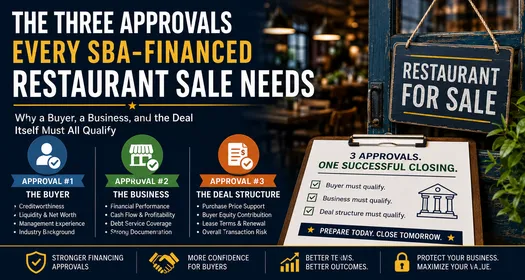
Three Approvals Every SBA-Financed Restaurant Sale Needs
Why the Buyer, the Business, and the Deal Must All Qualify
When a restaurant owner decides to sell, finding an interested buyer may seem like the biggest challenge.
For an SBA-financed transaction, however, buyer interest is only the beginning. The lender must be comfortable with three separate parts of the transaction:
- The buyer
- The restaurant
- The deal structure
A weakness in any one of these areas can delay financing, force the parties to restructure the transaction, or prevent the sale from closing.
Understanding these three approvals can help buyers and sellers prepare more effectively.
Approval #1: The Buyer
The lender first determines whether the buyer is financially and operationally qualified to acquire the restaurant.
The review commonly includes:
- Credit history
- Available cash
- Personal net worth
- Existing debt obligations
- Management experience
- Restaurant or hospitality experience
- Personal financial statements
- Tax returns
- Résumé and business plan
The lender wants confidence that the buyer can make the required investment, manage the business successfully, and meet the obligations of the loan.
A buyer with limited restaurant experience may strengthen the application by retaining experienced management, involving a qualified operating partner, or presenting a detailed transition plan.
Approval #2: The Restaurant
A strong buyer cannot overcome a restaurant that does not generate enough documented cash flow.
The lender must determine whether the business can support:
- Loan payments
- Normal operating expenses
- A reasonable income for the new owner
- Working-capital needs
- Other existing obligations
- A financial cushion for unexpected challenges
Documents commonly reviewed include:
- Business tax returns
- Profit-and-loss statements
- Balance sheets
- POS reports
- Bank statements
- Payroll records
- Sales trends
- Business debt schedules
- Lease documents
Clean, consistent records make it easier for the lender to understand the restaurant’s actual performance.
Unsupported sales, questionable add-backs, or large differences between tax returns and internal statements can create financing problems.
Why Debt-Service Coverage Matters
One of the lender’s most important calculations is the debt-service coverage ratio, commonly called DSCR.
DSCR compares the restaurant’s available cash flow with its required debt payments.
In simple terms, the lender wants to see that the restaurant generates more cash than is needed to make the loan payments.
A business that produces only enough cash to cover the debt leaves little room for:
- Seasonal declines
- Equipment repairs
- Higher food costs
- Labor increases
- Unexpected operating expenses
Stronger debt coverage provides greater protection for the buyer and lender.
Approval #3: The Deal Structure
Even when the buyer and restaurant qualify, the transaction itself must still make financial sense.
The lender may evaluate:
- Whether the purchase price is supported by earnings
- The buyer’s equity contribution
- The amount of working capital included
- The value of equipment and other assets
- The amount of goodwill
- Seller-financing terms
- Existing business debt
- Lease length and renewal options
- Whether real estate is included
- The overall risk of the transaction
A profitable restaurant may still be difficult to finance if the purchase price is too high or the lease is too short.
Likewise, a qualified buyer may need to contribute more cash, negotiate seller financing, or revise the purchase terms to make the transaction work.
The Lease Can Affect All Three Approvals
For most independent restaurants, the lease is a critical part of the financing review.
Lenders and buyers typically want:
- Enough remaining lease term to support the loan
- Reasonable renewal options
- Sustainable rent
- Clear assignment rights
- Landlord approval when required
- No unresolved defaults
A restaurant may have strong earnings, but the deal can still fail if the buyer cannot secure acceptable occupancy terms.
Sellers should review the lease before listing the business rather than waiting until a buyer is already in underwriting.
What Sellers Can Do Before Listing
Restaurant owners can improve the likelihood of financing by preparing early.
Before bringing the business to market, sellers should:
- Organize tax returns and financial statements
- Reconcile sales with POS reports and bank deposits
- Review profitability trends
- Identify supportable owner add-backs
- Evaluate likely debt-service coverage
- Update equipment and asset lists
- Review the lease and renewal options
- Identify outstanding liens or obligations
- Understand the restaurant’s realistic market value
- Address operational weaknesses
Some sellers also seek a preliminary financing review before listing. This cannot guarantee approval for a future buyer, but it may reveal issues that can be corrected in advance.
What Buyers Should Do Early
Buyers should become prequalified before making serious offers.
Early lender discussions can help establish:
- A realistic acquisition budget
- The likely down payment
- Required cash reserves
- Experience requirements
- Personal credit concerns
- Whether a particular restaurant appears financeable
Prequalification is not final approval, but it can prevent buyers from pursuing transactions that are unlikely to fit their financial profile.
When One Approval Falls Short
Many financing problems can be solved by restructuring the deal.
Possible adjustments may include:
- Reducing the purchase price
- Increasing the buyer’s equity contribution
- Adding seller financing
- Including more working capital
- Extending the lease
- Adjusting the transition plan
- Retaining key management
- Resolving undocumented expenses
- Paying off existing obligations
The earlier a weakness is identified, the more options the parties usually have.
The Bottom Line
An SBA-financed restaurant sale requires more than an interested buyer.
The buyer must qualify.
The restaurant must qualify.
The deal structure must qualify.
When all three align, financing becomes more achievable and the transaction is more likely to move efficiently toward closing.
Preparation allows sellers to identify potential problems before the lender does and gives buyers a clearer path to completing the acquisition.
Ready to Buy or Sell a Restaurant?
SellYourRestaurant.com was built specifically for restaurant owners, buyers, brokers, and hospitality investors. Our platform helps buyers discover restaurant opportunities while giving sellers the tools to market their business confidentially and professionally.
Reach qualified buyers. Protect your business. Close the deal.
This article is for general informational purposes only and should not be considered legal, financial, tax, lending, or professional advice.