Three to Six Months in New York: The Permit Timelines That Can Stall a Restaurant Closing
DUE DILIGENCE
Liquor, health, fire and local business permits don't come with the keys. A buyer's guide to what changes hands, what doesn't, and what to budget.
By SYR Staff | Oct 15, 2026
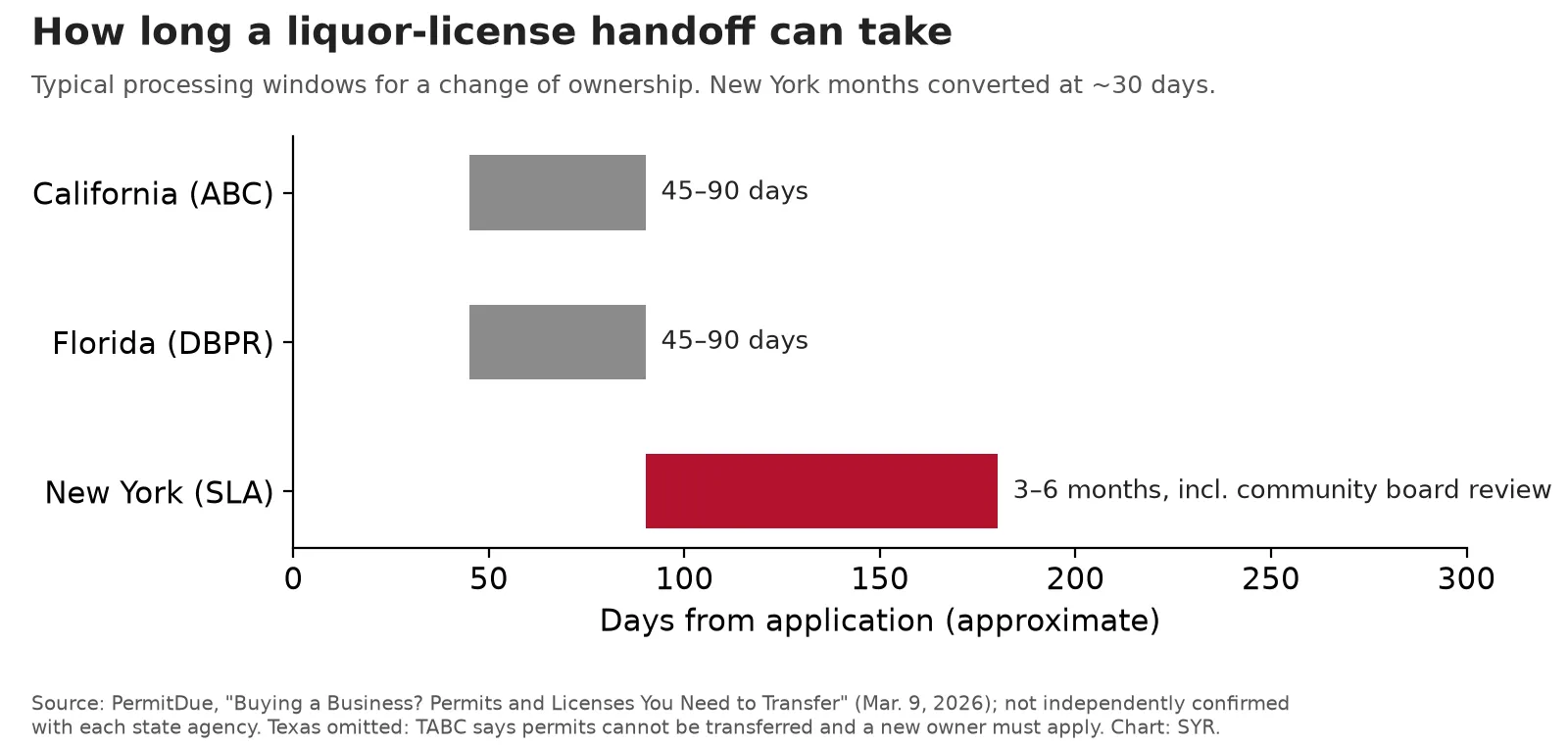
Typical liquor-license change-of-ownership windows, by state. Source: PermitDue (Mar. 9, 2026). Texas omitted: TABC says licenses and permits can't be transferred. Chart: SYR.
The lease, the equipment and the recipes transfer at closing. Most government permits don't. They are issued to a person or an entity, so when ownership changes, each agency takes a fresh look at the new owner. A March guide from permit-tracking service PermitDue maps out what restaurant buyers should expect, and New York stands out for how long it takes.
Liquor license windows, per PermitDue
- New York (State Liquor Authority): 3 to 6 months, including the same community board review a new license gets. Temporary permits become available after that review.
- Florida (DBPR): 45 to 90 days with new background checks. Quota (4COP) licenses get extra scrutiny. Temporary permits are available.
- California (ABC): 45 to 90 days for a person-to-person transfer, with a $100 temporary operating permit that lets the buyer serve in the meantime.
- State transfer fees: roughly $200 to $6,700, depending on the state and license type.
Texas works differently. PermitDue describes a transfer there, but the Texas Alcoholic Beverage Commission says licenses and permits can't be transferred to a new owner, who must apply for their own. Plan for a new application.
“You can inherit a violation without inheriting the permit.”
The rest of the permit stack
- Health permit: usually a new application and often a change-of-ownership inspection. Policies vary by county, so call before closing.
- City or county business license: tied to the entity, so a new owner or LLC needs its own, typically $50 to $500 and one to two weeks.
- Certificate of occupancy: stays with the building as long as the use doesn't change.
- Fire permits and inspection records: stay with the property, but open code violations become the buyer's problem.
- Music licensing: ASCAP, BMI and SESAC agreements belong to the licensee, so the buyer needs new ones.
Before you close
- Collect copies of every permit, license and registration, and confirm each one is current.
- Request violation and complaint records from the health department, fire department and alcohol board.
- Ask each agency, in writing, what a change of ownership requires.
- Set the closing date, lease deadlines and financing deadlines around the slowest approval.
- Budget roughly $2,000 to $10,000 for transfer-related costs, PermitDue suggests.
You can inherit a violation without inheriting the permit. A records request is the cheapest diligence a buyer will do.
Key Takeaways
- New York liquor transfers can take 3 to 6 months, including community board review.
- Florida and California typically run 45 to 90 days. Texas requires a new application.
- Open health, fire and alcohol-board violations pass to the buyer.
- Budget about $2,000 to $10,000 for permit transfers and get each agency's requirements in writing.
Sources
PermitDue, "Buying a Business? Permits and Licenses You Need to Transfer" (Daniel Amar, Mar. 9, 2026): https://permitdue.com/blog/buying-a-business-permit-transfers
Texas Alcoholic Beverage Commission, FAQs: https://www.tabc.texas.gov/faqs/
Images and Graphics
Chart: original SYR chart built from PermitDue's published state timelines (Mar. 9, 2026); New York's 3 to 6 months shown as about 90 to 180 days.